Construction project schedule: a UK manager's guide
A comprehensive guide for UK construction professionals on mastering the construction programme, from logic links to baseline management.
By James Shorter ·
Construction project schedule: a UK manager’s guide

TL;DR:
- A construction project schedule is a detailed, time-based plan that sequences activities, assigns durations, and maps dependencies to guide a project from start to finish. Proper management of these schedules involves weekly updates, active resequencing, and integrating procurement processes to prevent delays and overruns. UK contracts impose specific scheduling obligations, such as managing constraints and aligning schedules with contractual milestones, which are essential for successful project delivery.
A construction project schedule is a detailed, time-based plan that sequences every project activity, assigns durations, maps dependencies, and allocates resources to guide a project from groundbreaking to handover. Known formally as a programme in UK contract practice, it is the single document that keeps trades, procurement, and client milestones aligned. Tools like Gantt charts, Primavera P6, and methods such as the Critical Path Method (CPM) and Last Planner System (LPS) sit at its core. Get it right and you control the project. Get it wrong and schedule overruns follow.
What are the main components of a construction project schedule?
A construction programme is built from six interlocking elements. Miss one and the whole plan loses integrity.
- Task identification and breakdown: Every scope item is broken into discrete, measurable activities. A commercial fit-out, for example, separates first-fix MEP, drylining, second-fix, and finishes into individual tasks rather than lumping them together.
- Task dependencies and sequencing: Activities link in logical order. Concrete cannot be poured before formwork is complete. These finish-to-start, start-to-start, and finish-to-finish relationships form the backbone of schedule logic.
- Duration estimates: Each activity carries a realistic time allowance based on output rates, crew size, and site conditions. Optimistic durations are the single most common cause of schedule drift.
- Resource allocation: Labour, plant, and materials are assigned to activities. Overloading a resource in week three creates a bottleneck that ripples through the rest of the programme.
- Milestones and critical deliverables: Key dates such as structural completion, building control sign-off, and practical completion anchor the schedule to contract obligations.
- Baseline schedule: Once agreed, the original programme is frozen as the baseline. All future progress is measured against it, and forensic analysis relies on a reliable baseline when disputes arise.
The term schedule of works is sometimes used interchangeably with construction schedule, but they are not identical. A schedule of works is typically a priced document attached to a contract, listing work items and their values. A construction programme is the time-based plan. Both are needed; neither replaces the other.
Gantt charts remain the most widely used visual format because they show task bars against a calendar, making overlaps and gaps immediately visible. For complex projects, a Gantt chart exported from Primavera P6 or Asta Powerproject gives planners a dynamic view they can update as conditions change.
| Schedule element | Primary purpose |
|---|---|
| Work breakdown structure | Organises scope into manageable activity groups |
| Logic links | Defines the sequence and dependency between tasks |
| Duration estimates | Sets realistic time allowances per activity |
| Resource histogram | Shows labour and plant demand across the timeline |
| Baseline programme | Provides the reference point for progress measurement |
| Milestone schedule | Tracks key contractual and client-facing dates |
Which scheduling methods work best for UK commercial projects?
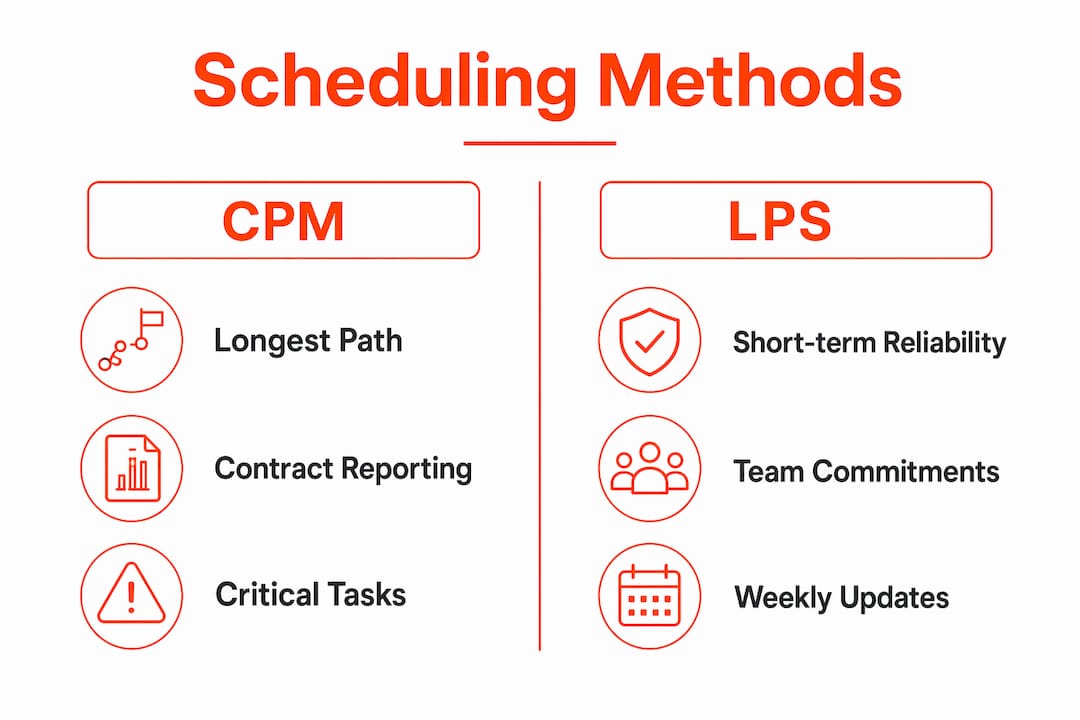
CPM and LPS are the two dominant methods in UK construction, and they serve different purposes. Understanding both is non-negotiable for any project manager working on commercial schemes.

Critical Path Method (CPM)
CPM identifies the longest chain of dependent activities from project start to finish. Any delay to a task on the critical path delays practical completion by the same amount. CPM is the contractual standard on most UK projects and is required under NEC contracts for programme submissions. Primavera P6 is the tool of choice for complex CPM programmes, though Asta Powerproject is widely used on mid-size UK schemes.
One technical decision that catches planners out is the critical path calculation setting in Primavera P6. The software offers two options: Longest Path and Total Float ≤ 0. Longest Path produces more reliable results, particularly on NEC contracts with sectional completions and terminal float. Total Float ≤ 0 can misidentify activities as critical when constraints are involved, creating a misleading picture of where the real schedule risk sits.
Last Planner System (LPS)
LPS shifts focus from long-range prediction to short-interval reliability. Teams commit only to work they can genuinely complete in the next one to three weeks, and performance is tracked using Percent Plan Complete (PPC). A PPC below 80% signals that the planning process itself needs attention, not just the individual tasks. Hybrid CPM and LPS use is common on complex UK commercial projects because CPM satisfies the contract while LPS drives execution reliability on site.
| Method | Best suited for | Key metric | UK contract fit |
|---|---|---|---|
| CPM | Contractual reporting, delay analysis | Float, critical path | NEC, JCT, FIDIC |
| LPS | Weekly execution planning, subcontractor coordination | Percent Plan Complete | Complements CPM |
| Primavera P6 | Large infrastructure, commercial schemes | Programme updates | NEC standard tool |
| Asta Powerproject | Mid-size UK commercial and residential | Gantt, resource | JCT common |
Pro Tip: Set Primavera P6 to calculate critical path using Longest Path rather than Total Float ≤ 0 on any NEC project with sectional completions. The difference in output can be significant and affects your contractual position.
How do you actively manage a construction schedule to reduce delays?
A construction programme is not a document you create once and file away. Keeping it as a living document is what separates projects that finish on time from those that drift. Active management means updating the schedule every week, not every month.
- Update progress weekly. Record actual start and finish dates, remaining durations, and percentage complete for every active task. Weekly updates catch slippage before it compounds.
- Resequence when conditions change. Weather delays, design changes, and equipment breakdowns all require a logic review. Adjust successor activities immediately rather than absorbing the delay silently.
- Use short-interval planning. A three-week lookahead, drawn from the master programme, gives site teams a workable target. Track PPC against those commitments and address root causes when tasks slip.
- Coordinate subcontractor interfaces. Subcontractor handover points are where delays most often originate. Managing subcontractor timing requires clear written commitments, not verbal agreements on site.
- Plan procurement in parallel. Long-lead items must be ordered before they appear on the critical path. Switchgear carries a lead time of 16–52 weeks, transformers 26–60 weeks or more, and glazing systems 16–24 weeks. Locking these orders during the permit review period removes a major source of schedule risk.
- Hold structured schedule review meetings. A weekly programme review with the site team, supported by a construction meeting checklist, keeps decisions documented and accountable.
Large UK commercial and infrastructure projects overrun schedules by around 20% on average, with only 25% completing close to their planned timelines. That figure is not inevitable. It reflects poor update discipline, unrealistic durations, and procurement planning that starts too late.
Pro Tip: Treat procurement of long-lead items as a schedule activity in its own right. Add it to theprogramme with its own logic links and milestone dates. If it slips, the programme flags it immediately rather than hiding it in a spreadsheet.
What UK contractual factors affect construction project scheduling?
UK construction contracts impose specific scheduling obligations that go beyond basic project planning. Ignoring them creates both programme risk and legal exposure.
NEC contracts require the contractor to submit a programme showing the critical path, float, and resource requirements at defined intervals. The contract administrator assesses the programme and either accepts it or raises objections. An unaccepted programme weakens the contractor’s position on delay and compensation events. On NEC projects, activity coding and work breakdown structure must reflect the contract structure, not just the construction sequence. This distinction matters when change management and delay analysis are required.
- Hard constraints: A hard constraint forces an activity to start or finish on a specific date regardless of logic. Hard constraints contaminate the critical path when they are not genuinely contractual or physical necessities. UK practitioners recommend reviewing every hard constraint before programme submission to confirm it is justified.
- Critical path definition: The choice between Longest Path and Total Float ≤ 0 in Primavera P6 directly affects which activities appear critical. On projects with sectional completions, the wrong setting can hide the true critical path from both the planner and the contract administrator.
- Stage gates on mega-projects: UK government guidance on mega-projects requires schedule detail to match the assurance stage. Early feasibility needs indicative timelines; later stages require full schedules to completion with phased progress updates. A single schedule format applied across all stages is a common and costly mistake.
- TM59 and TM52 compliance milestones: Commercial new-builds in London and other urban areas must meet TM59 overheating compliance requirements. These assessments have their own lead times and must be built into the programme as formal milestones, not afterthoughts.
| Contractual factor | Schedule impact | Recommended action |
|---|---|---|
| NEC programme acceptance | Unaccepted programme weakens delay claims | Submit on time, address objections promptly |
| Hard constraints | Can falsify critical path | Review and remove unjustified constraints |
| Sectional completions | Affects float and critical path calculation | Use Longest Path setting in Primavera P6 |
| Long-lead procurement | Drives schedule risk if ordered late | Integrate procurement as schedule activities |
| Stage gate requirements | Mismatched detail wastes effort | Match schedule depth to assurance stage |
Construction task tracking aligned to these contractual milestones gives project managers a clear audit trail when delay events need to be evidenced.
Key takeaways
A construction project schedule controls cost, quality, and time only when it is built with accurate logic, maintained weekly, and aligned to UK contract requirements.
| Point | Details |
|---|---|
| Build on solid logic | Map all task dependencies before setting durations to avoid false critical paths. |
| Choose the right method | Use CPM for contractual reporting and LPS for weekly execution reliability on complex schemes. |
| Manage procurement actively | Order long-lead items during permit review to prevent them from driving schedule delays. |
| Review constraints rigorously | Remove hard constraints that are not contractually required to preserve schedule integrity. |
| Update the programme weekly | A schedule updated monthly is a historical record, not a management tool. |
Why most UK schedules fail before work even starts
The uncomfortable truth I have observed across UK commercial projects is that most schedule failures are baked in at the planning stage, not caused by events on site. Teams spend weeks producing a detailed Gantt chart, submit it for NEC acceptance, and then treat it as a finished product. The programme sits in a folder while the project runs on WhatsApp messages and verbal instructions.
The root problem is that scheduling is treated as a compliance exercise rather than a risk management tool. Realistic duration setting is the first casualty. Planners under pressure from commercial teams shorten durations to hit a client-driven completion date, and the resulting programme has no float to absorb the inevitable. When I look at programmes that have gone wrong, the critical path is almost always contaminated by unjustified hard constraints that nobody reviewed before submission.
The hybrid CPM and LPS approach genuinely works on complex projects. CPM satisfies the contract. LPS keeps the site team honest about what they can actually deliver next week. The two methods reinforce each other when they are run together, and PPC data from LPS gives you early warning of systemic problems before they show up on the master programme.
Digital tools matter, but not in the way most teams think. The value is not in the software itself. It is in the discipline that good project coordination practices force on a team. When communications, RFIs, and variation instructions are captured in one place, the schedule update process takes minutes rather than hours. That is where the real time saving sits in 2026.
— James
How BRCKS supports construction scheduling for UK builders
Keeping a construction programme current depends on fast, accurate communication between site and office. When updates live in WhatsApp threads and email chains, the schedule is always one missed message behind reality.

BRCKS is built for UK builders who need their project communications and schedule coordination in one place. Its WhatsApp integration captures site updates in real time, auto-generates site diaries, and tracks RFIs and variations without manual data entry. That saves project managers over two hours of admin every day. Teams using BRCKS for builders report fewer miscommunications, better-documented delay events, and client portals that keep stakeholders informed without interrupting site workflows. If your programme is only as good as the information feeding it, BRCKS closes that gap. Try it free for 14 days.
FAQ
What is a construction project schedule?
A construction project schedule is a time-based plan that sequences all project activities, assigns durations and resources, and maps dependencies to guide a project to completion. In UK contract practice it is commonly called a programme.
What is the difference between CPM and LPS?
CPM identifies the longest chain of dependent activities and is used for contractual reporting. LPS focuses on short-interval planning and reliability, tracking Percent Plan Complete to improve execution on site.
How often should a construction programme be updated?
A construction programme should be updated weekly. Monthly updates allow slippage to compound and reduce the schedule’s value as a management tool.
Why do UK construction projects overrun their schedules?
Large UK commercial and infrastructure projects overrun by around 20% on average, driven by unrealistic duration estimates, late procurement of long-lead items, and poor update discipline after the baseline is set.
What are long-lead items and why do they matter?
Long-lead items are materials or equipment with extended procurement times, such as switchgear at 16–52 weeks or transformers at 26–60 weeks. Ordering them late places them on the critical path and directly delays project completion.
Recommended
- Top Construction Schedule Software for UK Builders 2025 | BRCKS
- UK Construction Project Coordination Best Practices 2026 | BRCKS
- Meeting Management Tips for UK Contractors | BRCKS
- BRCKS | Construction Project Communication Software
How BRCKS Can Help
Mastering a construction schedule is essential for keeping UK projects on track and avoiding costly delays. BRCKS simplifies this process by providing intuitive tools that streamline task management and real-time collaboration across your entire site team. By centralising your timeline and communication, BRCKS ensures every stakeholder remains aligned from groundworks to completion. We invite you to explore our platform today to see how we can help you deliver your next project with greater precision and ease. Learn more at BRCKS and explore our full feature set.