Document management in UK construction: £21bn problem solved
Poor document management costs the UK construction sector £21 billion annually. Learn how adopting digital tools and structured workflows can protect your margins and ensure compliance.
By James Shorter ·
Document management in UK construction: £21bn problem solved
TL;DR:
- Poor document management causes delays, rework, and compliance risks costing billions annually.
- Digital tools like CDEs improve version control, accessibility, and audit trails, reducing errors.
- Leadership and consistent processes are crucial for successful digital transformation in UK construction.
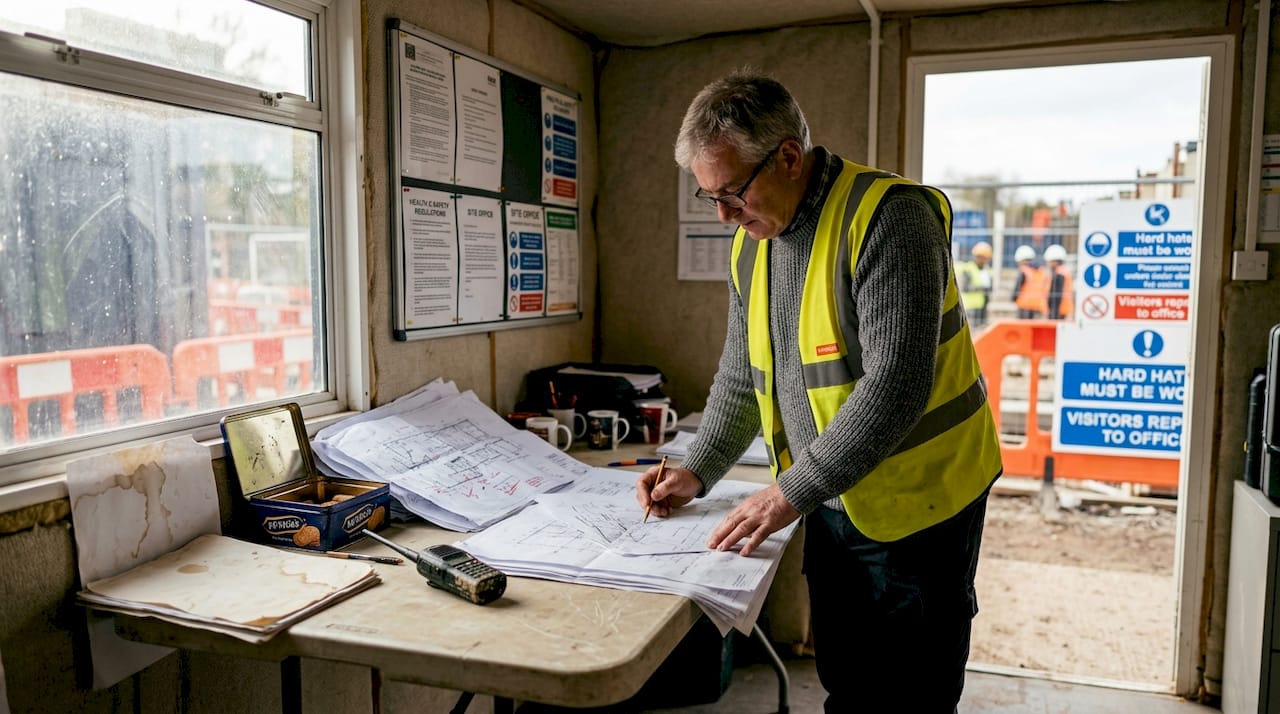
Poor document management is quietly draining UK construction projects of time, money, and credibility. Rework costs £21 billion annually across the UK construction sector, and a significant share traces back to lost drawings, outdated specifications, and miscommunication between teams. If you are a project manager juggling subcontractors, clients, and compliance obligations, you already know the daily frustration of chasing the right version of a document. This article breaks down why document management matters so much, what good practice looks like, and how digital tools can help you recover time, reduce risk, and deliver projects that run smoothly from groundbreak to handover.
Table of Contents
- The real cost of poor document management in construction
- What effective construction document management looks like
- How digital document management delivers savings and reduces risk
- Real-world pitfalls and overcoming UK construction documentation challenges
- Why most firms underestimate document management — and what truly works
- Next steps: smarter construction document management with BRCKS
- Frequently asked questions
Key Takeaways
| Point | Details |
|---|---|
| Document chaos costs billions | Ineffective document management wastes up to £21 billion a year in UK construction through rework and lost productivity. |
| Digital DMS boosts compliance | Adopting digital solutions simplifies meeting UK regulatory standards and reduces the risk of compliance fines. |
| Audit trails resolve disputes | Contemporaneous digital records and version control help quickly settle project arguments and protect your firm. |
| Smart adoption is key | Successful transition to digital requires phased adoption, hands-on training, and a focus on simple, repeatable processes. |
The real cost of poor document management in construction
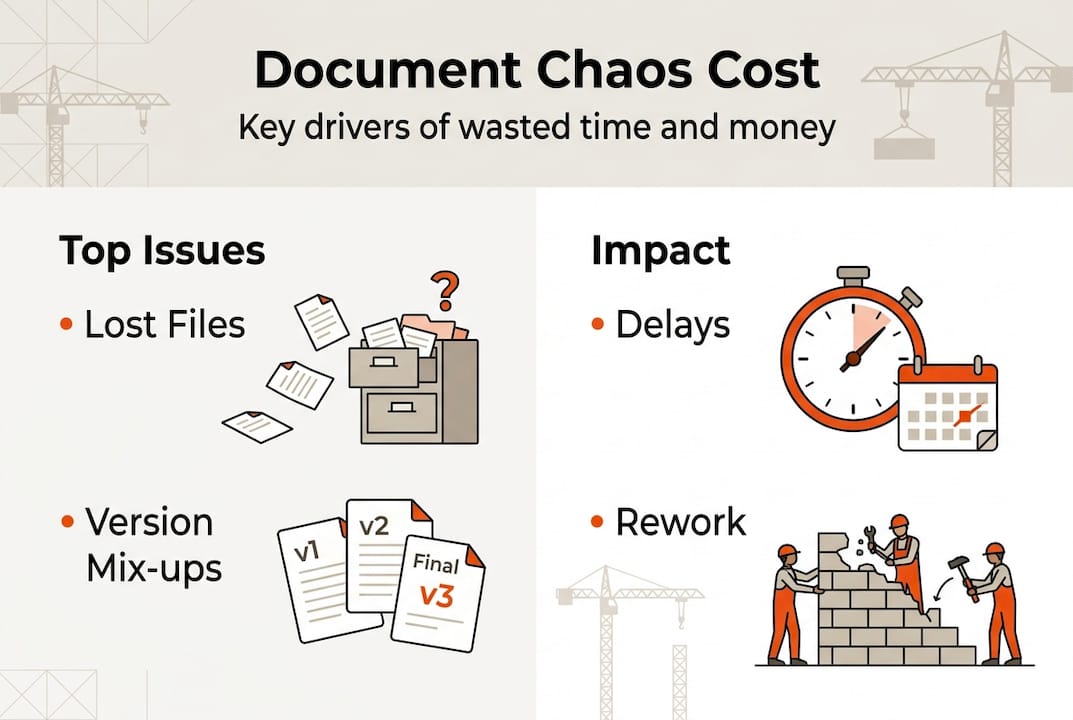
The numbers are difficult to ignore. Rework accounts for 21% of total sector output in the UK, and document failures sit at the heart of many of those costly mistakes. When a subcontractor builds to an outdated drawing because no one circulated the revision, the knock-on effects ripple through the entire programme. Delays, abortive work, and client disputes all follow.
The time drain is just as significant. Professionals spend 5 to 15% of their working day searching for documents, and 34% of UK firms report experiencing document loss. In 18% of those cases, the result is a compliance issue. That is not a minor inconvenience. On a regulated site, a missing health and safety file or an unsigned inspection record can trigger an HSE investigation.
Improving your construction communication workflow is one of the fastest ways to reduce these risks. When information sharing in construction is structured and traceable, errors fall sharply.
Here is a snapshot of the typical impact poor document management has on a mid-sized UK project:
| Problem area | Estimated impact |
|---|---|
| Time lost searching for documents | 5 to 15% of working hours |
| Rework as share of project output | Up to 21% of total cost |
| Firms experiencing document loss | 34% of UK construction firms |
| Compliance issues from document loss | 18% of affected firms |
“25% of project time is spent on rework or rectifying issues across UK construction projects.”
The day-to-day headaches are familiar to any site manager. Drawings printed and left in a site hut become unreadable after rain. Email chains grow so long that the latest revision is buried beneath dozens of replies. Subcontractors arrive on site with different versions of the same plan. These are not edge cases. They are routine failures that standard document workflows are specifically designed to prevent.
The compliance picture adds another layer of urgency. CDM 2015 places clear duties on principal contractors and designers to maintain specific records throughout a project’s life. Failing to produce those records when required is not just embarrassing — it can result in significant fines and even prosecution.
What effective construction document management looks like
Effective document management is not simply about storing files in a shared folder. It is a structured approach that controls how documents are created, reviewed, approved, distributed, and archived. The foundation of this approach in modern UK construction is the Common Data Environment, or CDE.
A CDE is a single, agreed source of information for a project. Every drawing, specification, report, and correspondence lives there. Team members access the same files, see the same version history, and work from the same approved data. The result is fewer misunderstandings and a clear audit trail if something goes wrong.

The key methodologies that underpin effective document management include centralised CDEs, robust version control, clear naming conventions, automated workflows, and compliance with BS ISO 19650 and CDM 2015. These are not optional extras for large contractors. They are increasingly expected across the supply chain.
Here is how paper-based and digital approaches compare in practice:
| Feature | Paper-based | Digital DMS |
|---|---|---|
| Version control | Manual, error-prone | Automatic, timestamped |
| Access permissions | Difficult to enforce | Role-based, auditable |
| Search and retrieval | Slow, unreliable | Instant, keyword-based |
| Compliance audit trail | Incomplete | Full and exportable |
| Remote access | Not possible | Available on any device |
Beyond the CDE, good document control relies on consistent naming conventions. Without them, files accumulate with names like “Final_v3_REVISED_USE THIS ONE,” which tells you nothing useful and creates real risk.
Pro Tip: Set your naming convention before the project starts. A simple structure such as ProjectCode_Discipline_DocumentType_Revision works well. Enforce it from day one and make it part of your subcontractor onboarding checklist.
For further guidance on getting your team aligned, reviewing coordination best practices and exploring software for builders will give you a practical starting point.
A well-implemented digital DMS guide will also walk you through the technical setup in detail, including how to configure permissions and automate approval workflows.
How digital document management delivers savings and reduces risk
The business case for digital document management is well established. The savings are real, measurable, and achievable for firms of all sizes.
One of the most cited examples is Balfour Beatty, whose DMS implementation saved $5M on a single project. That figure comes from reduced rework, faster information retrieval, and fewer costly disputes. For a UK project manager, the lesson is straightforward: the upfront investment in a proper system pays back quickly.
Disputes are where document management earns its keep most visibly. When a contractor and client disagree about what was agreed, who approved what, and when a change was instructed, the outcome often depends on the quality of the records. Digital DMS prevents disputes by providing timestamped audit trails and version control that leaves no room for ambiguity.
Key benefits of digital document management on UK construction projects:
- Faster retrieval of drawings, specifications, and correspondence
- Automatic version control that eliminates “which drawing is current” confusion
- Secure, role-based access that keeps sensitive information protected
- Reduced rework through accurate, real-time information sharing
- Clear audit trails that support dispute resolution and regulatory compliance
Understanding the hidden costs of software is important when evaluating options, but the money saving guide for builders shows that the return on investment is typically strong. A well-structured workflow management guide will also help you see where document management fits into your wider operational improvements.
Pro Tip: Start keeping contemporaneous digital records from day one of a project. A timestamped log of decisions, approvals, and communications is your strongest defence if a dispute arises months or years later. Do not wait until things go wrong to start documenting.
The industry benchmark report confirms that firms adopting digital tools consistently report fewer disputes and faster project completion. The evidence points in one direction.
Real-world pitfalls and overcoming UK construction documentation challenges
Moving from paper to digital is not always straightforward. Many firms encounter predictable problems, and knowing them in advance helps you avoid them.
On site, paper documents face physical risks that are easy to underestimate. Rain, dust, and general site conditions destroy printed drawings. Version conflicts emerge when different trades are working from documents printed on different dates. These are not technology problems. They are process problems that technology alone cannot fix without the right habits in place.
Paper damage, version conflicts, GDPR compliance, and resistance to digital adoption are consistently cited as the key challenges facing UK firms making this transition. Data security is a genuine concern, particularly for firms handling sensitive client information or commercially sensitive designs. Choosing a UK-hosted CDE with clear GDPR compliance documentation is essential, not optional.
Resistance from site teams is common and understandable. People who have worked with paper for decades are not going to embrace a new system simply because management says so. 44% of UK firms plan to adopt DMS platforms within 12 months, which means a lot of teams are currently working through exactly these adoption challenges.
Understanding why digital collaboration fails is the first step to avoiding those same mistakes in your own organisation.
Here is a practical approach to transitioning from paper to digital:
- Audit your current document types and volumes before choosing a platform
- Select a CDE that meets BS ISO 19650 and is hosted in the UK for GDPR compliance
- Run a pilot on a single project or workstream before rolling out across the business
- Appoint a process champion on each project to drive adoption and answer questions
- Provide focused, role-specific training rather than generic system walkthroughs
- Review and refine your naming conventions and folder structure after the pilot
“The firms that succeed with digital document management are not the ones with the most sophisticated software. They are the ones with the clearest processes and the most consistent habits.”
Following relevant construction regulatory norms and keeping your compliance documentation current throughout the transition will protect you during any audit or inspection.
Why most firms underestimate document management — and what truly works
Here is an uncomfortable truth: most UK construction firms treat document management as an administrative task rather than a strategic one. They buy software, set up a folder structure, and assume the problem is solved. It rarely is.
The real barrier is not technology. It is leadership. When a project manager does not enforce the naming convention, does not insist on version control, and does not follow up when documents are shared outside the CDE, the system breaks down within weeks. No platform can compensate for inconsistent leadership.
The firms that get this right share one characteristic. They treat document management as a discipline, not a feature. They appoint someone accountable, they review compliance regularly, and they make it part of their project induction process.
Simple tools used consistently beat sophisticated platforms used poorly every time. A basic CDE with clear rules and genuine enforcement will outperform an expensive system that nobody follows. Keep an eye on your site monitoring guide for practical ways to build accountability into your day-to-day processes.
Pro Tip: Focus on process before platform. Define your document control rules, get buy-in from your team leads, and only then choose the technology that supports those rules.
Next steps: smarter construction document management with BRCKS
The evidence is clear. Better document management reduces rework, protects you in disputes, and saves your team significant time every week. The question is where to start.
BRCKS brings file sharing, team communication, checklists, and client updates into one platform built specifically for construction teams. You can share documents, track approvals, and keep your entire project team aligned without switching between multiple tools. Whether you are a builder looking for software for builders that fits how you actually work, a project manager seeking reliable construction communication software, or a team leader exploring why choose BRCKS over other platforms, you can get started with a free 14-day trial and see the difference immediately.
Frequently asked questions
What are the biggest risks of poor document management in UK construction?
Poor document management leads to project delays, costly rework, and compliance fines, contributing to £21 billion in annual losses across the UK construction sector. Regulatory breaches and HSE investigations are also a real risk when records cannot be produced on demand.
How does digital document management help with UK compliance?
Digital DMS supports BS ISO 19650 and CDM 2015 compliance by maintaining version histories, full audit trails, and secure, role-based access to all project records. This makes it straightforward to demonstrate compliance during inspections or audits.
What key features should a construction DMS have?
The essentials are a centralised CDE, robust version control, automated approval workflows, clear naming conventions, and strong access permissions that reflect each team member’s role on the project.
How can UK project managers address resistance to DMS adoption?
Start with a pilot project, provide role-specific training, and appoint process champions who can support colleagues through the change. Up to 15% of working time is currently lost to document searching, so the time savings quickly become apparent to sceptical team members.
What regulatory documents must be managed in UK construction?
CDM 2015 mandates specific records including the Construction Phase Plan and the Health and Safety File. These must be maintained throughout the project and handed over at completion, making structured document management a legal requirement rather than a best practice.
Recommended
- BRCKS | Construction Project Communication Software
- Construction Software for Builders | BRCKS
- BRCKS | Construction Project Communication Software
- BRCKS | Construction Project Communication Software
How BRCKS Can Help
While the £21 billion cost of poor document management remains a significant hurdle for the UK construction industry, it is a challenge that modern technology is finally equipped to solve. BRCKS provides the centralised, intuitive platform needed to eliminate administrative bottlenecks and ensure your project data remains accurate and accessible. By streamlining these essential workflows, we help your team focus on delivery rather than searching for lost paperwork. We invite you to see how BRCKS can transform your operational efficiency by booking a demo or exploring our features today. Learn more at BRCKS and explore our full feature set.