Meeting management tips for UK contractors that deliver results
Discover essential meeting management strategies for UK contractors to eliminate project delays, improve accountability, and streamline site communication.
By James Shorter ·
Meeting management tips for UK contractors that deliver results
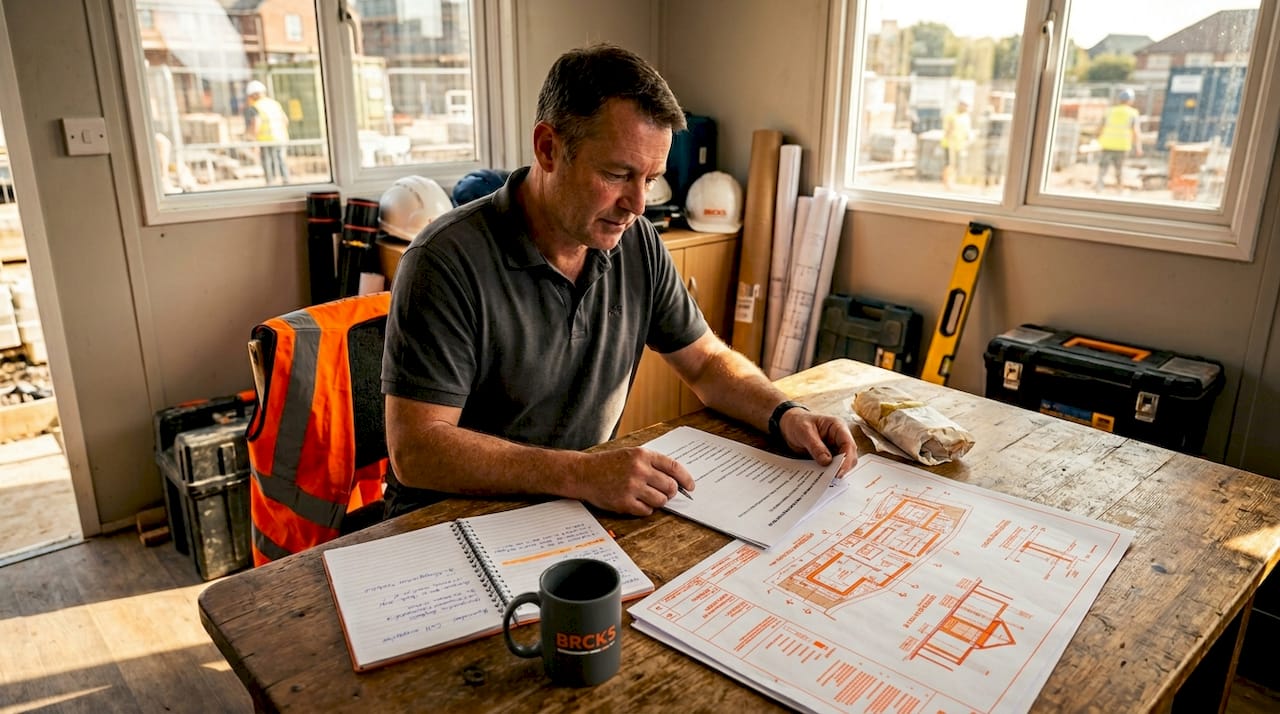 A purpose-built construction snagging software keeps these items tracked through to sign-off.
TL;DR:
- Poorly managed site meetings cause project delays, rework, and strained subcontractor relationships in UK construction. Establishing structured agendas, tracking actions rigorously, and integrating safety and risk management improve meeting effectiveness and project outcomes. Using digital platforms like BRCKS automates routines, enhances accountability, and streamlines communication for better project delivery.
Missed actions, unclear ownership, and agendas that appear five minutes before kick-off. Sound familiar? For UK contractors and project managers, poorly run meetings are not just an inconvenience — they are a direct cause of delays, rework, and strained subcontractor relationships. With build programmes tightening and compliance requirements growing more complex by the year, the pressure to run sharper, more effective site meetings has never been greater. This article sets out practical, field-tested strategies to help you structure meetings properly, track actions rigorously, and get every attendee leaving with clear next steps.
Table of Contents
- Establish clear meeting criteria and agenda
- Track actions and follow up with escalation
- Define communication channels and regular meeting rhythm
- Integrate health and safety checks into every meeting
- Surface risks early and document impacts proactively
- Our perspective: why most contractor meetings miss the mark
- Cut meeting admin and boost project delivery with BRCKS
- Frequently asked questions
Key Takeaways
| Point | Details |
|---|---|
| Prepare detailed agendas | Send focused, time-boxed agendas to all attendees at least 48 hours in advance. |
| Action tracking and escalation | Log actions visibly and implement escalation for unresolved or repeated delays. |
| Standardise communication routines | Use regular meetings and agreed digital tools to keep all parties coordinated. |
| Integrate health and safety | Make H&S a standing agenda item to ensure compliance and competence on site. |
| Proactively manage project risks | Surface and record project risks early in meetings to prevent future delays or cost overruns. |
Establish clear meeting criteria and agenda
With the stakes set, let us focus first on laying the groundwork: getting your meeting agenda and criteria right.
A site meeting without a structured agenda is little more than a group conversation. Everyone is in the room, but nobody leaves knowing who is doing what or by when. The fix is straightforward: circulate a detailed agenda at least 48 hours before every meeting. This gives attendees time to gather progress updates, review drawings, and flag issues before they arrive. It also signals that the meeting is purposeful and worth attending.
Time-boxing is equally important. Assign a specific duration to each agenda item and appoint someone to manage the clock. This prevents a single topic from consuming the entire session while genuinely critical items get squeezed into the final five minutes.
“Allocate time to each item and stick to it. Park items that need more time into a separate meeting rather than letting them overrun and derail the rest of your agenda.”
Following coordination best practices means agreeing in advance which items belong on the agenda and which should be parked. A simple parking-lot process, where off-topic issues are noted and scheduled separately, keeps your meeting focused and respects everyone’s time.
Here is what a strong agenda framework covers:
- Previous actions and carry-forwards with status updates from responsible parties
- Programme and progress against the build schedule
- Procurement and material deliveries with upcoming deadlines flagged
- Design queries and RFIs requiring decisions
- Health and safety updates, incidents, and upcoming works
- Project risks and early warnings raised by any party
- Any other business (strictly limited and time-capped)
Pro Tip: Require attendees to submit progress updates or completed checklists 24 hours before the meeting. This shifts the burden of preparation onto individuals rather than the chair, and it means your reduce rework with communication workflows efforts start before the meeting even begins. Good agenda planning tips can also help you sequence items logically, putting decision-heavy topics early when energy is highest.
Track actions and follow up with escalation
Once your agenda sets expectations, it is crucial to ensure decisions and actions do not get lost. Here is how to drive accountability.

The most common reason meetings fail to move projects forward is simple: nobody tracks what was agreed. People leave with good intentions, but without a visible, shared record, actions slip. A practical approach is to maintain a running action tracker that carries forward unresolved items to the next meeting. Every attendee can see what is outstanding, and nothing conveniently disappears.
Here is a step-by-step process to make action tracking work:
- Log every action in real time during the meeting, including the responsible party and agreed completion date
- Distribute the action log within 24 hours of the meeting closing, not at the following session
- Require written status updates from responsible parties before the next meeting, not verbal updates on the day
- Carry forward any incomplete action with a red status flag so it is immediately visible
- Escalate persistent non-delivery to the relevant project lead, and document that escalation formally
The escalation step is where most teams fall short. Without consequences, some attendees will repeatedly defer actions and face no real accountability. A formal escalation process, documented in writing and visible to the project lead, changes that dynamic quickly.
| Feature | Simple action log | Action log with escalation protocol |
|---|---|---|
| Ownership visibility | Basic | Clear and documented |
| Carry-forward process | Manual, inconsistent | Automatic, visible to all |
| Accountability mechanism | Verbal reminder | Written escalation to project lead |
| Audit trail | Limited | Full chronological record |
| Impact on non-performance | Low | Significant, with consequences |
Pro Tip: Good workflow optimisation starts with automating your reminders. If your action tracker can send automatic nudges to responsible parties three days before a deadline, you remove the need for the meeting chair to chase individually. This is exactly the kind of friction-reducing habit that separates high-performing teams from those constantly firefighting.
Linking your action tracking to your approach to decision tracking for projects and managing subcontractors ensures you have a single, coherent record of what was decided and who is accountable at every tier of the project.
Define communication channels and regular meeting rhythm
With actions tracked, consistent communication keeps your whole team aligned between meetings.
Agreeing on communication channels sounds basic, but it is the step most contractors skip. The result is a chaotic mix of WhatsApp messages, emails, phone calls, and verbal site conversations, where critical information falls through the gaps. At the start of every project, define exactly which tool is used for which purpose and document it. Post it somewhere every team member can find it.
Setting a fixed meeting rhythm is equally important. Weekly or bi-weekly check-ins reduce miscommunication and keep momentum steady. Ad hoc meetings called at short notice signal poor planning and tend to draw low attendance. When everyone knows the meeting is every Tuesday at 8:30am, it becomes a predictable part of the project routine rather than an interruption.
Shared digital calendars are a practical way to give visibility across the whole team. Schedule every meeting, action deadline, and milestone in one place so that nobody can claim they were unaware. Use construction schedule software that integrates with your communication tools to make this seamless.
| Tool | Advantages | Drawbacks |
|---|---|---|
| Instant, familiar, widely used | Unstructured, messages easily missed | |
| Formal record, good for documents | Slow, siloed, hard to search | |
| Shared calendar (e.g. Google Calendar) | Visible to all, reduces scheduling conflicts | Requires everyone to adopt it consistently |
| Dedicated project management platform | Centralised, auditable, integrates actions | Requires onboarding time |
| Phone calls | Fast for urgent queries | No record, information lost |
Refer to the site monitoring guide for practical advice on keeping field teams connected, and explore improving communication strategies that work across different project sizes and structures.
Integrate health and safety checks into every meeting
Staying compliant is not just checking a box. Meetings are the ideal place to manage project risks and team safety.
Health and safety must be a permanent item on every contractor meeting agenda. Not a tick-box at the end, but a substantive discussion with time allocated. Ongoing supervision and checking contractor suitability and competence is a legal obligation, and the site meeting is your best opportunity to evidence that obligation is being met.
What this looks like in practice:
- Review any incidents or near-misses from the past period and confirm corrective actions are in place
- Confirm that all operatives hold relevant qualifications such as CSCS cards, specific trade licences, or IPAF/PASMA certifications where required
- Distribute or confirm receipt of risk and method statements (RAMS) for upcoming works
- Flag any changes to site conditions that affect the existing risk assessment, such as new excavations, temporary works, or changes to access routes
- Record attendance to demonstrate that H&S briefings were given
Statistic: The Health and Safety Executive reports that the construction industry accounts for a disproportionate share of workplace fatalities in Great Britain each year, with many incidents linked to inadequate planning, supervision, and communication of safety controls. Regular, documented safety discussions in meetings are one of the most effective preventative measures available to project managers.
Embedding H&S into your standard meeting format also sends a clear cultural signal. When safety is always on the agenda, operatives understand it is not optional. Contractors who treat it as a recurring, documented conversation rather than an annual induction tend to have fewer incidents and stronger relationships with their supply chain.
Surface risks early and document impacts proactively
Beyond day-to-day tasks, meetings are where future project challenges are best flagged and handled.
This is where the philosophy of your contract form can directly shape how you run your meetings. NEC-based projects are built around proactive, collaborative risk management with early warnings and forward-looking assessment of time and cost impacts. In practice, this means your meetings should include a dedicated section for emerging risks, not just a review of what has already gone wrong.
Here is a practical process for proactive risk management in site meetings:
- Include a standing ‘project risks’ agenda item where any party can raise a concern without prejudice
- Require teams to flag near-misses and emerging issues as early as possible, even before they become problems
- Record every risk with a proposed mitigation action, an owner, and a target resolution date
- Log early warnings in a separate register and reference them at subsequent meetings to track progress
- Document the time and cost implications of each risk as they become clearer, rather than waiting for a formal valuation
“NEC’s approach to early warning and collaborative risk assessment represents a significant departure from the retrospective, adversarial nature of traditional contract management. When teams discuss risks openly in meetings and record impacts contemporaneously, disputes become far less likely.”
This approach is directly linked to avoiding project overruns. Understanding the causes of over-budget UK projects reveals that most cost growth originates from risks that were identifiable early but not surfaced or acted upon. A money-saving project management mindset starts with disciplined early warning, not reactive damage control.
JCT contracts, by contrast, tend toward retrospective assessment and formal instruction, which makes contemporaneous recording even more important. Whatever your contract form, the meeting is where your paper trail begins.
Our perspective: why most contractor meetings miss the mark
Here is an uncomfortable truth. Most contractor meetings fail not because of poor agendas or the wrong format. They fail because follow-through is treated as optional. Everyone nods at the action log. Nobody is genuinely held accountable when items carry forward week after week.
The real problem is cultural. When a project manager lacks the authority or the will to enforce consequences for unprepared attendees or missed actions, the meeting becomes a ritual rather than a management tool. Attendees learn quickly that showing up is enough, and that commitments made in the meeting room rarely translate to consequences outside of it.
What actually changes culture is transparency combined with predictable consequences. When every attendee can see the same action log in real time, and when an escalation pathway is activated automatically after a missed deadline rather than left to the discretion of the chair, behaviour changes. Not because people are afraid, but because the expectation becomes normalised.
Pro Tip: If you are still relying on manually updated spreadsheets and email chasers, you are spending time on administration that could be spent on actual project delivery. Test-run automated reminders through a digital platform for a single project. The reduction in chasing alone tends to justify the switch.
The brands insight we would share is this: meetings succeed when action tracking, communication, and escalation are predictable routines rather than exceptions that depend on one person’s diligence. When those routines are built into your tools rather than your habits, they become resilient. Explore real-world savings that come from replacing manual processes with structured digital workflows.
Cut meeting admin and boost project delivery with BRCKS
If you have recognised your own team’s meetings in any part of this article, you are not alone. The good news is that the fixes are well within reach, and the right platform makes implementation straightforward rather than burdensome.

BRCKS is built specifically for UK construction teams and brings together automated agendas, live action tracking, and centralised communication in one platform. Whether you are coordinating a small residential build or managing multiple subcontractor packages on a commercial scheme, BRCKS helps you run meetings that actually move projects forward. From construction software for builders to WhatsApp team tools that keep your trades connected without forcing anyone off their preferred device, and snag list solutions that close out issues on site, BRCKS gives you the infrastructure to make every strategy in this article work in practice. Get BRCKS free for 14 days and see the difference structured meeting management makes to your project outcomes.
Frequently asked questions
How much notice should UK contractors give for a site meeting?
You should issue meeting agendas at least 48 hours before each session to ensure all parties can prepare adequately. Last-minute agendas lead to underprepared attendees and wasted meeting time.
What are the best ways to keep contractor meetings on track?
Time-box every agenda item, maintain a running action tracker with carry-forward visibility, and activate a formal escalation process when actions are not completed. Structure and consequence together drive compliance.
How often should contractor progress meetings be held?
Weekly or bi-weekly meetings are recommended for most UK contractor projects, supported by shared digital calendars and agreed communication channels between sessions.
Why is health and safety a recurring topic in contractor meetings?
Ongoing H&S discussions are a legal requirement under UK construction regulations, ensuring contractor suitability and competence are continuously monitored, documented, and evidenced across the project lifecycle.
What is the difference between NEC and JCT contracts for meeting management?
NEC favours proactive risk discussion and contemporaneous records in meetings, supporting early warning assessment of time and cost impacts, while JCT relies more heavily on retrospective assessment and formal written instructions.
Recommended
- UK Construction Project Coordination Best Practices 2026 | BRCKS
- BRCKS | Construction Project Communication Software
- BRCKS - Construction Software That Ends WhatsApp Mayhem
- Top Construction Schedule Software for UK Builders 2025 | BRCKS
How BRCKS Can Help
Effective meeting management is the cornerstone of a successful project, but even the best strategies require the right tools to stay on track. By integrating your communication and site data within BRCKS, you can ensure that every action item is backed by real-time insights and held to clear accountability. Our platform simplifies the administrative burden of coordination, allowing your team to focus on delivery rather than chasing updates. We invite you to see how BRCKS can transform your project workflows by booking a demo or exploring our features today. Learn more at BRCKS and explore our full feature set.