What is an action item in projects?
Poor management of action items often causes construction delays. Learn how to properly assign, document, and track commitments to ensure project success.
By James Shorter ·
What is an action item in projects?
 A purpose-built construction snagging software keeps these items tracked through to sign-off.
TL;DR:
- Poor management of action items often causes construction delays by lacking clear ownership, deadlines, and records. Properly assigning, documenting, and tracking these commitments transforms discussions into tangible progress and risk mitigation. Implementing real-time recording and digital tools like Brcks enhances accountability, improves project outcomes, and reduces delays.
Poor action item management is one of the most overlooked causes of construction delays. On busy sites, teams walk out of meetings with a shared sense of what needs doing, but no written record of who is doing it or when it must be finished. That gap is exactly where costs rise, disputes begin, and projects stall. Understanding what is an action item in projects, and how to use them correctly, is one of the simplest improvements any UK construction team can make. This article cuts through the confusion and gives you a practical framework you can apply immediately.
Table of Contents
- Key takeaways
- What an action item is (and is not) in construction
- Purpose of action items in project accountability
- Pitfalls and best practices for action items on site
- Frameworks and tools for tracking action items
- Corrective vs preventive action items on construction sites
- My honest take on action items in construction
- How Brcks helps you manage action items
- FAQ
Key takeaways
| Point | Details |
|---|---|
| Action items have three parts | Every action item needs a task description, a named owner, and a deadline. |
| They differ from general tasks | Action items arise from meetings; deliverables and project tasks are longer-term outcomes. |
| Ownership must be individual | Assigning to a group causes the bystander effect and reduces completion rates. |
| Document them live | Recording action items during the meeting prevents confusion and misattribution later. |
| Technology closes the gap | WhatsApp-native platforms like Brcks support real-time assignment and follow-up on site. |
What an action item is (and is not) in construction
The definition of action items is straightforward, but frequently misapplied. An action item is a specific, assigned commitment that arises from a meeting or project discussion. It has three non-negotiable components: a clear task description, a single named owner, and a firm deadline. Remove any one of those and it becomes a vague intention rather than a managed commitment.
Construction teams often treat meeting minutes, decisions, and action items as the same thing. They are not. A decision is a conclusion reached in the meeting. A note is context or background information. An action item is what someone must physically do as a result. Action items are not long-term deliverables; they are immediate commitments that feed into those deliverables.
Examples of action items in construction projects:
| Weak (avoid) | Strong (use this) |
|---|---|
| “Sort out the scaffolding issue” | “John Smith to contact scaffolding contractor and confirm revised erection date by Friday 18 July” |
| “Look into the window supplier delay” | “Sarah Jones to request written update from window supplier and circulate to team by Wednesday 16 July” |
| “The site manager will deal with snagging” | “Tom Reeves to complete snagging walkthrough on Block B and issue list to client by 25 July” |
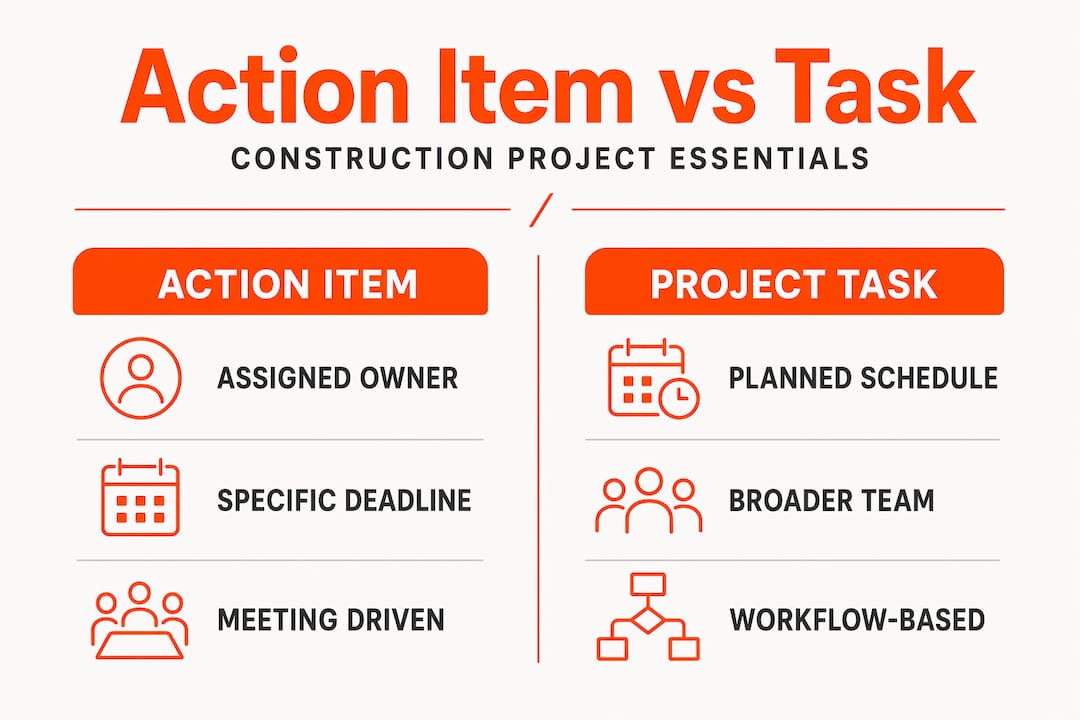
The distinction between an action item vs task is also worth clarifying. A project task is a planned activity within your programme, often with dependencies and resourcing attached. An action item emerges in real time, usually from a conversation, and needs a fast response. Complex action items should be promoted to formal project tasks once they require scheduling and resource allocation.
Pro Tip: Write action items in the imperative form. Start with a verb and name the owner first. “Tom Reeves to submit RFI by 20 July” is clearer and harder to misread than “RFI submission is needed.”
Purpose of action items in project accountability
The purpose of action items in projects goes beyond creating a to-do list. When written correctly, they create a documented accountability trail that protects everyone on the project, from the site manager to the main contractor.

The role of action items in meetings is to transform discussion into forward motion. Without them, conversations repeat themselves week after week. With them, each meeting starts with a review of what was agreed previously, making it immediately clear what has been completed and what has slipped. This structure alone changes team behaviour.
Here is why action items matter specifically in construction:
- Accountability: Naming one person removes ambiguity. Every team member knows exactly what they are responsible for before they leave the room.
- Audit trail: A written record of action items protects you commercially. If a subcontractor disputes a decision or a client claims they were not informed, your action item log is evidence.
- Prioritisation: Connecting action items to project objectives helps teams understand which tasks have the highest consequence if missed, making it easier to allocate time and effort appropriately.
- Momentum: Projects stall when discussions produce no output. Action items convert intent into movement, and movement keeps programmes on track.
“Minutes stating ‘issue discussed’ without actionable follow-up are ineffective.” — Construction meeting minutes guidance
The commercial reality of construction means that unresolved action items carry real financial risk. Delays in procurement decisions, outstanding design queries, and unclosed RFIs all begin life as action items that nobody followed through on. Tracking them properly is not administrative overhead. It is risk management.
Pitfalls and best practices for action items on site
Only 50% of action items are typically completed on time, and 80% of teams experience project rollover because action items were not properly tracked. These figures are not surprising to anyone who has worked in busy construction environments. What is surprising is how preventable most failures are.
Follow these practices to close the gap:
- Name one individual. Never assign an action item to “the project team” or “the site manager role.” Assigning to groups triggers the bystander effect, where everyone assumes someone else will act.
- Apply the 60-second test. If you cannot explain the action item in under 60 seconds, it is probably too vague to be actionable. Tighten the description before the meeting ends.
- Use the 24-hour rule. Require assignees to confirm receipt and provide an initial status update within 24 hours. This prevents items from being forgotten the moment people step off site.
- Promote complex items. If an action item requires more than a few days, dependencies, or multiple contributors, raise it to a formal project task within your programme so it gets the correct level of tracking and resourcing.
- Number action items sequentially. Across meetings, a running number (e.g., AI-047) allows you to reference, close, and audit items without confusion. This is especially useful on projects running over several months.
- Document them live, not after. Efficient teams record action items during the meeting rather than reconstructing them from memory an hour later. Mistakes and omissions in post-meeting notes are common and costly.
Pro Tip: Nominate a dedicated note-taker for every site meeting. Their sole job during the meeting is to capture decisions and action items in real time. This role rotation also builds shared ownership of the process across the team.
Frameworks and tools for tracking action items
Knowing how to create action items correctly is only half the work. The other half is tracking them consistently across a project’s life cycle.
A practical starting point is the 15-minute weekly meeting. This framework structures a short, focused check-in around three questions: What commitments were made last week? What is blocking progress now? What are the priorities for the coming week? Applied consistently across two to twelve concurrent construction projects, this meeting format keeps action items visible and ensures every blocker has a named owner.
Your meeting minutes should be structured to separate three distinct categories cleanly:
| Category | What to include |
|---|---|
| Decisions | Agreements reached, approvals given, options selected |
| Notes | Background context, information shared, observations |
| Action items | Owner, task description, due date, reference number |
Separating action items from minutes prevents the common problem where important commitments are buried in paragraphs of discussion text. A standalone action tracker table appended to your minutes makes review at the next meeting fast and unambiguous.
When it comes to technology, the advantages of digital action trackers over manual spreadsheets include real-time updates, automatic notifications, and searchable history. Spreadsheets get overwritten. Emails get missed. A platform that sits where your team already communicates removes that friction entirely.
Brcks is built specifically for this. Because it integrates with WhatsApp, action items assigned on site reach the right person through the channel they already check. For small and medium UK builders managing multiple projects, this kind of native integration means action items do not slip into inboxes that nobody monitors between site visits. You can explore how Brcks supports meeting management for UK contractors to see this in practice.
Corrective vs preventive action items on construction sites
Within regulated construction environments, there is an important distinction between two types of action items that many site teams handle informally but should document with the same rigour as any other commitment.
Corrective actions address existing problems. Something has gone wrong and the action item exists to fix it and prevent recurrence. Preventive actions address potential problems before they materialise, based on observation, risk assessment, or inspection findings.
On a UK construction project, both types arise regularly:
- Corrective action example: “Site manager to arrange immediate repair to temporary edge protection on Level 3 following this morning’s inspection. Due: today.”
- Preventive action example: “H&S coordinator to review scaffold inspection schedule and confirm monthly checks are booked for all active structures by 30 July.”
Both require the same three components as any action item: a named owner, a clear description, and a deadline. The difference lies in the trigger. Corrective actions are reactive. Preventive actions are proactive.
Under the Building Safety Act and related regulations, maintaining a clear audit trail of how hazards were identified, assigned, and resolved is not optional. Whether you are reporting to the Health and Safety Executive or demonstrating due diligence to a client, your corrective and preventive action records are part of that evidence base. Treat them with the same discipline you would apply to a formal structural design check.
My honest take on action items in construction
I’ve worked with UK construction teams long enough to know that most project managers understand what action items should look like in theory. The problem is in the room. Meetings run over, notes get scribbled on someone’s pad, and by the time the minutes are written up the following day, half the context is already gone.
What I’ve seen change team behaviour most is not a new template or a better agenda. It is the moment a site manager starts naming owners out loud during the meeting and writing them down in real time. That one shift in habit makes accountability visible to everyone in the room, not just the person holding the pen.
I’ve also seen the commercial consequences when this does not happen. Disputes over who agreed to what, programmes extended because a procurement query sat unresolved for three weeks, relationships with clients damaged by avoidable miscommunication. Every one of those situations started with an action that was discussed but never properly owned.
My honest view is this: the quality of your action item management reflects the quality of your project management. A team that writes clear, owned, time-bound action items and reviews them every week will consistently outperform a team that does not, regardless of the complexity of the project.
— James
How Brcks helps you manage action items
If your current process relies on emailed minutes and WhatsApp messages scattered across group chats, you are not alone. Most UK construction teams manage this way, and most accept the confusion that comes with it. Brcks was built to solve exactly that.
As a construction management platform for builders, Brcks integrates with WhatsApp so your team assigns, tracks, and closes action items in the channel they already use every day. No new app to learn. No inbox to monitor. Action items reach the right person instantly, with automatic follow-up so nothing slips through.
For small and medium builders managing multiple live projects, Brcks saves over two hours daily by consolidating communication, task tracking, and documentation into one place. Get started with a free 14-day trial and see what a properly managed action item process looks like in practice.
FAQ
What is an action item in a construction project?
An action item in a construction project is a specific task with a named owner and a deadline, arising from a meeting or project discussion. It differs from a general project task in that it requires immediate attention and follow-up.
How does an action item differ from a project task?
An action item is a short-term commitment created in real time during a meeting. A project task is a planned activity within the programme, often with dependencies and resourcing attached. Complex action items should be promoted to formal tasks when they require more structured management.
Why is ownership so important for action items?
Assigning to groups reduces completion rates because of the bystander effect, where individuals assume someone else will act. Naming one person per action item removes that ambiguity entirely.
What is the role of action items in meetings?
The role of action items in meetings is to convert discussion into concrete, assigned commitments. They give every meeting a measurable output and provide a structured basis for reviewing progress at the following session.
How should action items be documented?
Action items should be recorded live during the meeting, separated clearly from decisions and notes, and compiled into a sequentially numbered tracker that is reviewed at every subsequent meeting.
Recommended
- BRCKS - Construction Software That Ends WhatsApp Mayhem
- UK Construction Project Management Terminology Guide | BRCKS
- Meeting Management Tips for UK Contractors | BRCKS
- Site Communication Workflow: UK Project Manager’s Guide | BRCKS
How BRCKS Can Help
Effectively managing action items is the cornerstone of keeping any construction project on schedule and within budget. By centralising these tasks within BRCKS, your team can eliminate ambiguity and ensure every responsibility is clearly assigned and tracked in real time. Our platform simplifies complex workflows, allowing you to focus on quality delivery rather than chasing updates. We invite you to explore how BRCKS can transform your project management approach and bring greater clarity to your next development. Learn more at BRCKS and explore our full feature set.