How a project feed transforms construction communication
Discover how a construction project feed centralises updates, reduces errors by up to 70%, and helps UK project managers streamline residential builds.
By James Shorter ·
How a project feed transforms construction communication

TL;DR:
- A construction project feed centralizes all updates, documents, and decisions, improving clarity and accountability.
- Using a structured feed can reduce errors and rework by up to 70% in residential construction projects.
- It enhances legal protection and transparency by providing an organised, timestamped record of project communications.
Managing a residential construction project means juggling dozens of moving parts at once. Subcontractors need updated drawings. Clients want progress reports. Site managers are fielding calls about decisions made three weeks ago that nobody can find in writing. When your project communication lives across WhatsApp threads, email chains, and verbal instructions, critical information gets lost and mistakes follow. A construction project feed changes this entirely, giving every team member a single, structured source of truth. This guide explains what a project feed is, why it matters, and how you can put one to work on your next residential build.
Table of Contents
- What is a construction project feed?
- Why construction project feeds matter: The cost of poor communication
- Core features of an effective construction project feed
- Putting project feeds into practice: What UK managers should know
- What most project managers miss about project feeds
- Streamline your project communication with BRCKS
- Frequently asked questions
Key Takeaways
| Point | Details |
|---|---|
| Centralised communication | A construction project feed stores updates, documents, and records in a single, organised hub. |
| Reduces costly errors | Project feeds have been shown to lower mistakes and rework by up to 70% on UK sites. |
| Boosts team accountability | Clear logs ensure everyone knows what decisions were made and when, improving ownership. |
| Speeds up decisions | Real-time updates mean faster approvals and fewer delays on site. |
What is a construction project feed?
A construction project feed is, at its core, a centralised hub where every update, document, decision, and task lives in one place. Rather than hunting through three different WhatsApp groups or scrolling back through weeks of emails, your team can open the feed and see exactly what has happened, what is pending, and who is responsible.
This is fundamentally different from a group chat or shared inbox. Email chains fragment information by thread and recipient. WhatsApp groups mix urgent site issues with casual conversation, making it nearly impossible to retrieve a specific instruction from six weeks ago. A dedicated project feed is structured, searchable, and tied directly to the project itself.
The core components of a well-built project feed include:
- Activity log: A chronological record of every update, comment, and status change on the project
- Document links and version control: Drawings, specifications, and contracts attached directly to the relevant update, so teams always access the current version
- Task assignments: Actions tied to specific people with due dates, visible to everyone with access
- Approval trails: A record of who approved what and when, invaluable for managing variations and sign-offs
- Permission controls: Different access levels for clients, subcontractors, and site managers
On a typical residential project, the people interacting through the feed include the project manager, site foreman, individual trades, the client, and sometimes a quantity surveyor or architect. Each role sees what is relevant to them. Clients get progress updates and can approve changes without being copied into every internal discussion. Subcontractors receive task assignments and can confirm completion directly in the feed.
The shift from scattered messaging to a structured improve communication guide approach is not just a technical upgrade. It changes how accountability works on site. When instructions are logged and visible, there is far less room for the classic “I never got that message” defence.
Why construction project feeds matter: The cost of poor communication
Poor communication is not just an inconvenience in UK residential construction. It is one of the leading drivers of rework, delay, and cost overrun. Think about the most common breakdowns you have seen: a subcontractor working from an outdated drawing, a variation approved verbally but never documented, a client complaint about something that was never formally agreed. These are not rare events. They are routine.
The numbers back this up. Information sharing cuts construction errors by up to 70% in UK projects when teams adopt structured communication systems. That is not a marginal improvement. It represents a fundamental reduction in the costly cycle of build, discover, rework, and rebuild.
| Communication method | Searchability | Audit trail | Document control | Client visibility |
|---|---|---|---|---|
| Poor | None | None | Informal only | |
| Limited | Partial | Version confusion | CC overload | |
| Dedicated project feed | Full | Automatic | Version controlled | Structured portal |
The communication crisis in construction is well documented. Rework alone accounts for a significant proportion of wasted spend on UK residential projects, and the majority of rework traces back to misunderstood or missing instructions. A project feed addresses this at the root. Every instruction is logged with a timestamp. Every document revision is clearly labelled. Every approval is recorded.
The practical benefits stack up quickly:
- Fewer phone calls chasing confirmations
- Faster approval cycles because clients can respond through the feed
- Reduced rework because teams always access the latest version of a drawing
- Clearer accountability when something does go wrong
Pro Tip: Set a rule on your project that no verbal instruction is considered confirmed until it appears in the project feed. This single habit eliminates a large proportion of the “I thought you meant” disputes that slow projects down.
The cost-benefit case is straightforward. Fewer errors mean less rework. Less rework means lower costs and faster handover. Faster handover means happier clients and more capacity for your next project.

Core features of an effective construction project feed
Not all project feeds are built equally. If you are evaluating platforms, knowing which features actually move the needle will save you from investing in a tool that ends up being another ignored app on the team’s phones.
Real-time updates are the foundation. When a drawing revision is uploaded or a task is marked complete, every relevant team member sees it immediately. This removes the lag between an update happening and the team acting on it, which is where many costly delays originate.
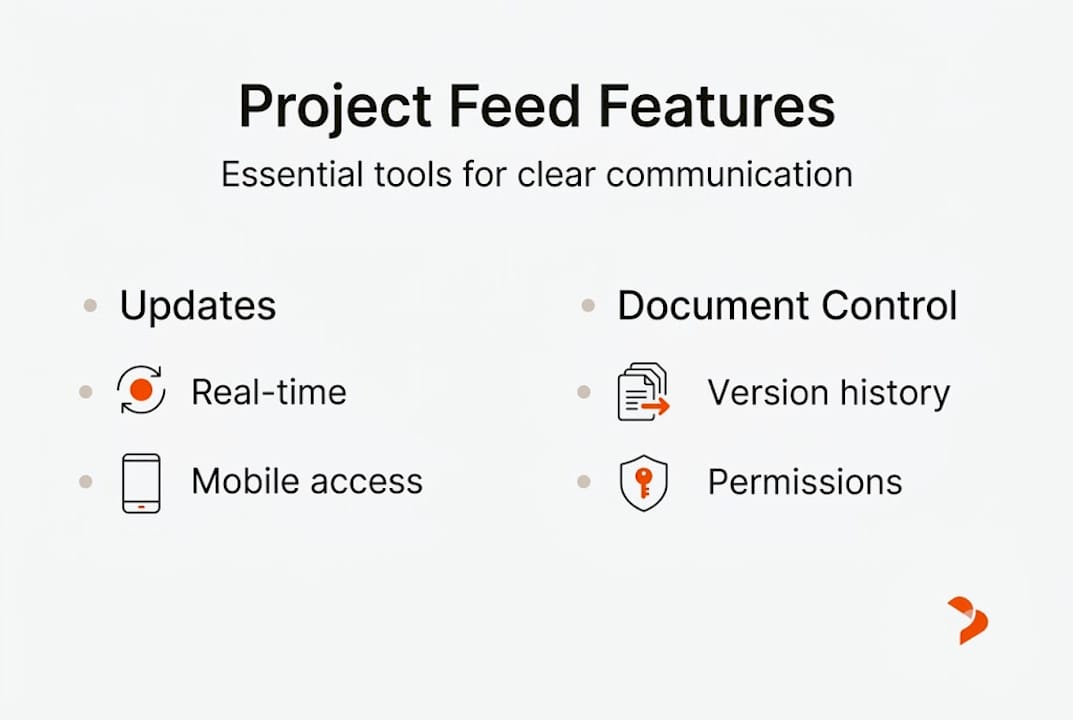
Searchable history is equally important. On a six-month residential build, you will generate hundreds of updates, decisions, and documents. Being able to search by keyword, date, or team member in seconds is not a luxury. It is a basic operational need.
The other features that separate a dedicated feed from a generic chat tool include:
- Attachment support with version control: Upload drawings and specifications directly to the relevant update, with older versions archived but accessible
- Task assignment and tracking: Create actions from any update, assign them to a specific person, and track completion without switching tools
- Permission controls: Ensure subcontractors see only what is relevant to their scope, and clients see progress without accessing internal discussions
- Integration with wider project management tools: The best platforms connect the feed to checklists, meeting notes, and file libraries
Consider a practical scenario. Your architect issues a revised ground floor plan. In a WhatsApp group, this gets uploaded, acknowledged by some, missed by others, and confused with the previous version within days. In a dedicated feed, the revision is uploaded with a clear label, linked to the affected tasks, and every relevant trade receives a notification. The old version is archived. There is no ambiguity.
The communication platform benefits extend beyond day-to-day efficiency. Clients report higher satisfaction when they can see structured progress updates rather than waiting for a weekly call. That transparency builds trust and reduces the volume of chasing calls you field each week.
Putting project feeds into practice: What UK managers should know
Understanding the value of a project feed is one thing. Getting your team to actually use it consistently is another. Here is a practical approach that works for UK residential project managers.
- Choose a platform built for construction. Generic project management tools lack the site-specific features that make a feed genuinely useful. Look for platforms that handle drawing revisions, subcontractor access, and client portals natively.
- Appoint a feed champion on each project. This is typically the site manager or project coordinator. Their job is to model consistent use and prompt others when updates are being posted outside the feed.
- Set clear guidelines from day one. Define what gets posted to the feed, by whom, and how quickly. A simple one-page protocol shared at the project kick-off meeting removes ambiguity.
- Onboard subcontractors properly. The most common failure point is trades reverting to WhatsApp because the feed feels unfamiliar. A short walkthrough at the start of their involvement pays dividends throughout the project.
- Review and iterate. After the first few weeks, check what is working and what is not. Are approvals happening faster? Are fewer instructions being missed? Adjust your process based on what the data shows.
A workflow cuts rework study found that proper communication workflows reduce project rework by 52% in UK construction. That figure is achievable, but only when the feed is used consistently across the whole team, not just by the project manager.
Pro Tip: Do not wait until problems arise to enforce feed discipline. Build the habit from the first day on site. Teams that start strong rarely regress.
Common pitfalls to avoid include ignoring permission settings (leading to information overload for subcontractors), failing to archive completed tasks (cluttering the active feed), and allowing parallel WhatsApp groups to persist alongside the feed. Address these early. You can explore specific communication problems and solutions and a detailed workflow management guide to support your rollout. Internationally, teams adopting structured feeds have seen similar gains, as shown in this Dutch project workflow example from a residential build in Breda.
What most project managers miss about project feeds
Most teams adopt a project feed thinking it is an IT upgrade. A better inbox. A tidier version of WhatsApp. That framing undersells it significantly and leads to half-hearted adoption.
The real value of a project feed is cultural. When every instruction, decision, and approval is logged and visible, the entire team operates with a higher level of accountability. People think more carefully before posting an update because it is on the record. That shift in behaviour is worth more than any individual feature.
There is also an underappreciated legal benefit. When a dispute arises over a variation, a delayed handover, or a defect claim, the project feed becomes your evidence base. Time-stamped logs showing what was instructed, by whom, and when can resolve disputes that would otherwise drag through months of correspondence. The insightful manager’s guide covers this in detail.
Looking forward, AI-powered search and analytics are beginning to surface patterns in project communication data. Feeds that are well maintained today will become even more valuable as these tools mature, giving project managers predictive insight into where delays and errors are likely to occur before they happen.
Streamline your project communication with BRCKS
If the communication challenges described in this article sound familiar, you are not alone. Most UK residential project managers are managing too many tools and not enough clarity.
BRCKS is built specifically for construction teams, with real-time project feeds, structured file sharing, client portals, and automatic audit trails all in one platform. Whether you manage a small residential team or coordinate multiple sites, dedicated builder software gives you the structure to reduce errors, speed up approvals, and keep every stakeholder informed. Explore the full construction communication platform and start a free 14-day trial to see the difference a purpose-built feed makes on your next project.
Frequently asked questions
How is a construction project feed different from WhatsApp or email?
A project feed is a dedicated platform that organises project information, documents, and tasks in one searchable, structured log, unlike scattered messages in WhatsApp or email where critical details are easily lost.
Can using a project feed really reduce mistakes on site?
Yes. Centralising updates through a project feed can cut errors by 70% in UK construction projects by ensuring every team member works from the same, current information.
What sized projects benefit most from a project feed?
Feeds add value at any scale, but they are especially critical for residential and mid-sized jobs with multiple subcontractors, as complex information flows are where communication breakdowns most often occur.
Will a project feed help with legal disputes or claims?
Yes. Feeds create automatically time-stamped records of every instruction and approval, and audit trails protect teams against communication loss when disputes or warranty claims arise.
Recommended
- Real-Time Updates in Construction: Boosting Project Success | BRCKS
- BRCKS | Construction Project Communication Software
- BRCKS | Construction Project Communication Software
- BRCKS | Construction Project Communication Software
How BRCKS Can Help
By centralising updates and streamlining real-time collaboration, a project feed eliminates the fragmented communication that often hinders construction progress. BRCKS integrates these dynamic feeds directly into your workflow, ensuring that every stakeholder remains aligned and informed without the need for endless email chains. This simple shift in how information is shared can significantly reduce errors and keep your projects on schedule. We invite you to explore how BRCKS can modernise your site management and help your team communicate more effectively. Learn more at BRCKS and explore our full feature set.