5 key benefits of project communication platforms
Poor communication costs UK construction £24 billion annually. Explore how digital platforms centralise documentation, reduce rework, and ensure projects finish on schedule.
By James Shorter ·
5 key benefits of project communication platforms
TL;DR:
- Poor communication in UK construction costs over £24 billion annually and delays project completion.
- Digital platforms improve communication, reduce rework, and save time through centralised updates and real-time issue tracking.
- Successful adoption requires addressing habitual workflows, choosing suitable tools, and ongoing process improvement.
Poor communication is costing UK construction dearly. Rework from poor communication costs the industry £24.62 billion annually, and projects with weak communication see only a 37% on-time completion rate. Disputes between contractors and subcontractors are widespread, budgets spiral, and goals go unmet. Project communication platforms exist to address exactly these problems. This article walks you through Why communication breaks down on site, what the right platform can deliver, how leading tools compare, and how to choose and implement the best fit for your team.
Table of Contents
- Why communication fails in construction projects
- Key benefits of construction project communication platforms
- Comparison of leading communication platforms for construction
- Maximising ROI: How to select and implement the right platform
- Why UK construction teams still underuse digital platforms
- Take the next step with project communication platforms
- Frequently asked questions
Key Takeaways
| Point | Details |
|---|---|
| Cut costly delays | Digital communication platforms help UK construction teams avoid rework and disputes that cost billions annually. |
| Boost team visibility | Platforms provide real-time updates and central information, reducing miscommunication and missed handovers. |
| Achieve fast ROI | Adopting the right platform can deliver impressive productivity gains and rapid cost savings, especially when implemented across all project phases. |
| Choose for compliance | Selecting platforms with robust audit trails and tracking ensures improved accountability and regulatory alignment. |
Why communication fails in construction projects
Construction projects are complex by nature. You have multiple trades working in sequence, subcontractors operating under different management structures, and clients expecting regular updates. When information is scattered across emails, WhatsApp threads, paper forms, and verbal handovers, things fall through the cracks fast.
The most common communication failings on UK sites include:
- Siloed teams that rarely share updates across disciplines
- Missed handovers between trades, leading to repeated work or safety gaps
- No single source of truth for drawings, specifications, or change orders
- Delayed issue escalation because there is no clear reporting channel
- Inconsistent documentation that makes disputes harder to resolve
These are not minor inconveniences. Only 37% of construction projects with poor communication finish on time, and less than half are delivered within budget. The knock-on effects touch every part of a project, from safety incidents caused by unclear instructions to costly rework that could have been avoided with a single shared update.
The communication problems in UK construction are not new, but they are getting harder to ignore as project complexity increases. Larger teams, tighter margins, and growing client expectations mean that informal communication habits no longer cut it. The reasons why projects fail from poor communication often trace back to structural issues: no agreed process, no shared platform, and no accountability trail.
The good news is that these are solvable problems. Digital platforms create the structure that informal communication cannot. They give every team member, from site manager to subcontractor, a consistent way to send updates, flag issues, and access the right documents at the right time. The result is fewer disputes, less rework, and projects that actually finish on schedule.

Key benefits of construction project communication platforms
Digital platforms centralise communication, provide real-time updates, and improve visibility across teams, reducing miscommunication and enhancing accountability. That is the core value proposition, but the practical benefits go further than that.
Here is what you can expect when a platform is properly adopted:
- Centralised documentation means everyone accesses the same version of drawings and specs
- Real-time issue tracking reduces the lag between problem identification and resolution
- Automated notifications keep subcontractors and clients informed without manual chasing
- Audit trails provide evidence for disputes and support compliance requirements
- Faster sign-off processes through digital checklists and approvals
The numbers back this up. Procore’s data shows that teams using their platform achieved 75% reduced rework, 51% fewer non-recoverable variations, and saved an average of 15 days per project. Those are significant gains for any project manager trying to protect margins.
“Efficiency gains of 15 days per project and 75% less rework are within reach when teams commit to a shared digital communication platform.”
Pro Tip: When evaluating platforms, prioritise those that offer full audit trails and action tracking. These features are not just useful for internal accountability; they are increasingly important for compliance with UK building safety regulations.
The benefits of improving project communication compound over time. Early adoption means your team builds habits around the platform, and those habits translate into faster issue resolution on every subsequent project. Information sharing that reduces errors is one of the clearest returns, and communication workflows that cut rework by over 50% are achievable with the right setup.
Comparison of leading communication platforms for construction
With benefits in mind, let us compare the tools that construction leaders are using in 2026. Each platform takes a different approach, and the right choice depends on your team size, project type, and existing systems.
BIM enables collaboration via shared 3D models, clash detection, and structured information management under ISO 19650. It is particularly powerful for large-scale projects where design coordination is a significant risk. However, BIM is a process as much as a tool, and smaller contractors may find the setup investment steep.
Paperless platforms cut admin by 90% and save 15 hours per week on site inductions alone. For contractors still relying on paper forms and manual sign-offs, this kind of platform delivers immediate, measurable gains.
CausewayOne saves 100 hours weekly on admin and offers over 950 mobile forms, making it well suited to plant-heavy or logistics-focused operations.
| Platform | Real-time updates | Document control | Admin savings | Compliance tools | Best suited for |
|---|---|---|---|---|---|
| BIM | Yes | Advanced | Moderate | Strong | Large, design-led projects |
| Procore | Yes | Advanced | High | Strong | Mid to large contractors |
| CausewayOne | Yes | Moderate | Very high | Moderate | Plant and logistics teams |
| Paperless platforms | Partial | Basic | Very high | Moderate | SMEs and site inductions |
| BRCKS | Yes | Integrated | High | Growing | All construction teams |
Consider mobile access carefully. Site teams rarely work from desks, so a platform that performs well on a smartphone is not optional. Also think about real-time platform updates and whether the tool integrates with your existing construction document control processes. Legacy system compatibility is a genuine barrier for some firms, particularly those using older ERP or finance tools.
Maximising ROI: How to select and implement the right platform
Armed with a comparison, here is how to make the best choice and ensure your investment pays off.
BIM reduces project costs by 15% and duration by 20%, with productivity gains of £5.10 to £6.00 per £1 invested. Even if BIM is not the right fit for your team today, those figures illustrate what structured digital adoption can deliver.
Follow these steps to select and roll out a platform effectively:
- Audit your current communication gaps. Identify where information is being lost, delayed, or duplicated.
- Define your must-have features. Mobile access, document control, subcontractor access, and client portals are common priorities.
- Shortlist two or three platforms and run a trial on a live project, not just a demo environment.
- Plan your training rollout before go-live. Partial adoption is one of the most common reasons platforms fail to deliver ROI.
- Set measurable targets. Track rework rates, issue resolution times, and admin hours saved from day one.
- Review at 90 days and adjust your workflows based on what the data shows.
Pro Tip: Focus on operational phase adoption for long-term productivity. Most teams invest heavily in pre-construction setup but lose discipline during the build. The biggest gains come from consistent daily use on site, not from the initial configuration.
The most common pitfalls are why digital collaboration fails in practice: legacy system barriers that prevent data flow, partial adoption where only some team members use the platform, and delayed data entry that undermines real-time visibility. Address these early. Practical site communication steps that embed the platform into daily routines make the difference between a tool that transforms your projects and one that collects dust.
| Case study snapshot | Time saved | Rework reduction | Admin cut |
|---|---|---|---|
| Procore (HMS) | 15 days per project | 75% | Significant |
| CausewayOne (Flannery) | 100 hrs/week | Not reported | Very high |
| Paperless platform (UK SME) | 15 hrs/week | Not reported | 90% |
Why UK construction teams still underuse digital platforms
Here is an uncomfortable truth: most UK construction firms have heard the case for digital platforms, and many have even trialled them. Yet adoption remains patchy. The reason is rarely about the technology.
The real barrier is habit. Site managers and project leads have built workflows around informal communication over decades. Asking them to log every update into a platform feels like extra work, even when it saves time overall. This is compounded by confusion between tools. Many teams conflate BIM with general project communication, not realising that BIM is an information management process under ISO 19650, not just 3D modelling.
What makes this particularly costly is that 73% of BIM’s benefits appear during operational use, yet most UK firms are not capturing them. The hidden costs of poor communication accumulate quietly, in rework, disputes, and missed deadlines, long after the project closes. Platforms are not a one-off fix. They require ongoing process improvement and leadership commitment to become genuinely transformative.
Take the next step with project communication platforms
The business case for switching to a purpose-built communication platform is clear. Fewer disputes, less rework, faster project delivery, and happier clients are all within reach when your team has the right tools in place.
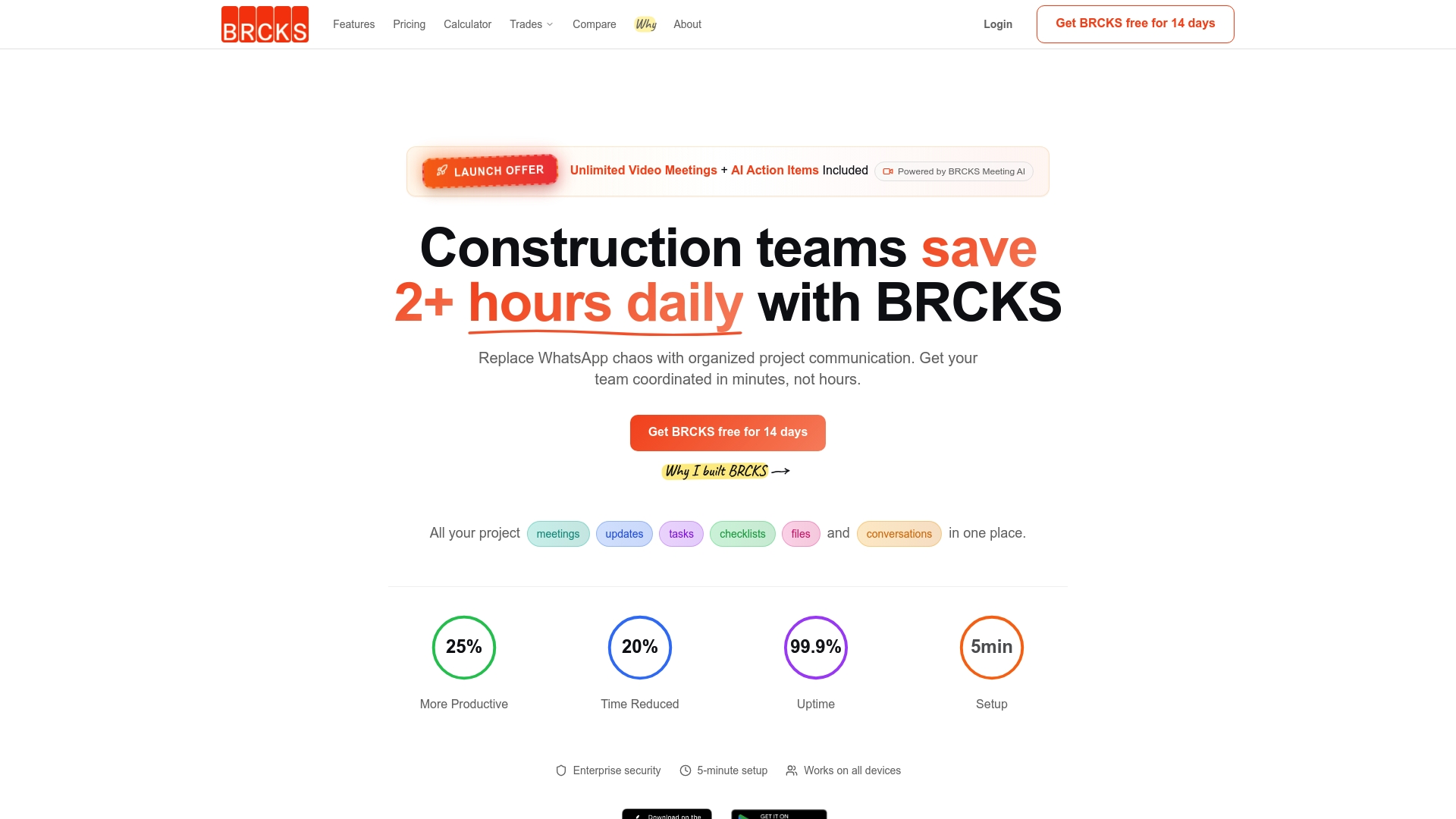
BRCKS is built specifically for UK construction teams, from small builders to large project operations. Whether you manage builders’ workflows, want to understand the central benefits of a connected platform, or are ready to explore a dedicated communication platform for construction, BRCKS brings your updates, tasks, files, and client communication into one place. Get BRCKS free for 14 days and see how much time your team gets back from day one.
Frequently asked questions
How do project communication platforms reduce construction rework?
Platforms cut rework by 75% by centralising updates and tracking issues in real time, ensuring every team member acts on the same, current information rather than outdated instructions.
What types of construction teams benefit most from these platforms?
All teams gain from better communication, but complex projects with multiple subcontractors and high data flow see the biggest impact, as centralised communication improves accountability across every layer of the project.
Are these tools difficult to integrate with existing systems?
Most modern platforms offer out-of-the-box integrations, but legacy integration barriers can affect smaller firms or those using older ERP systems, so it is worth testing compatibility before committing.
How much time can be saved per week with the right platform?
Depending on your current processes, platforms save between 15 and 100 hours per week through digitised admin, automated notifications, and streamlined site inductions.
Recommended
- Improve Site Communication: 5 Steps for UK Construction | BRCKS
- BRCKS | Construction Project Communication Software
- BRCKS | Construction Project Communication Software
- BRCKS | Construction Project Communication Software
- 7 vantaggi del time-lapse nei cantieri per project manager
How BRCKS Can Help
Effective communication is the cornerstone of any successful build, and adopting the right digital tools can significantly reduce costly misunderstandings on site. BRCKS is designed specifically to streamline these interactions, ensuring that every stakeholder remains aligned from initial groundworks to final handover. By centralising your project data and dialogue within our intuitive platform, you can eliminate information silos and focus on delivering quality results. We invite you to discover how BRCKS can transform your project management experience by exploring our features today. Learn more at BRCKS and explore our full feature set.