Construction project tracking: a practical guide for UK teams
A practical guide for UK construction teams on mastering project controls, critical path management, and weekly reporting loops to prevent project delays.
By James Shorter ·
Construction project tracking: a practical guide for UK teams

TL;DR:
- Construction project tracking involves regularly measuring progress against plans to prevent delays. Daily updates, critical path management, and external constraints are essential for proactive project control and timely completion.
Construction project tracking is the systematic process of recording and analysing actual progress against a planned schedule to enable proactive decisions and prevent delays. Without it, project managers react to problems rather than prevent them. The Critical Path Method (CPM) remains the industry standard for identifying which tasks directly control the end date, and weekly reporting loops are far more effective than monthly reviews for catching schedule drift early. This guide covers the core disciplines of task tracking in construction, from critical path management to external constraints, with practical methods proven on UK sites.
What is construction project tracking and why does it matter?
Construction project tracking is the practice of consistently measuring where a project stands against its baseline schedule, budget, and scope. The industry term for this discipline is “project controls,” and it goes well beyond simply noting percentage completion. Real project control requires a feedback loop: data collected, analysed, escalated, and acted upon within a timeframe that still allows course correction.

Many project managers mistake monitoring for control. Monitoring means recording what happened. Control means using that data to change what happens next. Without the second step, you are running what practitioners call “monitoring theatre”: data collection with no corrective action attached.
The importance of task management in construction becomes clear when you consider what goes wrong without it. Coordination failures, not technical complexity, cause most construction delays. A missed handover between trades, an unresolved RFI, or a late material delivery can each trigger a cascade of knock-on delays if no one is tracking dependencies in real time.
How does the critical path affect your tracking priorities?
The Critical Path Method defines a critical path as the sequence of tasks with zero float. Float is the buffer time a task can slip before it affects the project end date. Tasks with float can absorb small delays. Tasks on the critical path cannot absorb any delay at all.
This distinction shapes every tracking decision you make. A two-week slip on a critical task can become an eight-week crisis once dependencies and downstream constraints compound. The same two-week slip on a task with three weeks of float is a non-event.
Effective tracking templates use visual indicators to make this distinction instantly readable:
- Red for critical path tasks with zero float
- Amber for tasks approaching their float limit
- Green for tasks with comfortable float remaining
- Grey for tasks not yet started but within the planning horizon
Colour coding removes the need to read every row in a schedule. A project manager scanning a weekly update can spot critical path movement within seconds. That speed matters when you are managing multiple subcontractors across several work packages.
Pro Tip: Set an automatic amber flag for any task that has consumed more than 50% of its float. By the time a task turns red, your window for corrective action is already narrow.
Early detection of critical path slips is the single most valuable outcome of disciplined task tracking. A slip caught on Monday can be recovered by Friday. A slip discovered at the monthly review meeting is almost always a delay.
How should you assign task ownership and run daily updates?
Every task must have one named individual responsible for it. Generic assignment to “the groundworks team” or “the M&E contractor” produces slippage because no single person feels accountable. When a task has one owner, that person knows they will be asked for an update at the end of the day.
A phase-based project structure makes ownership clearer. Organising tasks by phase (groundworks, structure, envelope, fit-out, commissioning) rather than by trade creates natural review points and reduces the cognitive load of tracking hundreds of individual items simultaneously. Each phase has a lead, and that lead owns the phase summary.
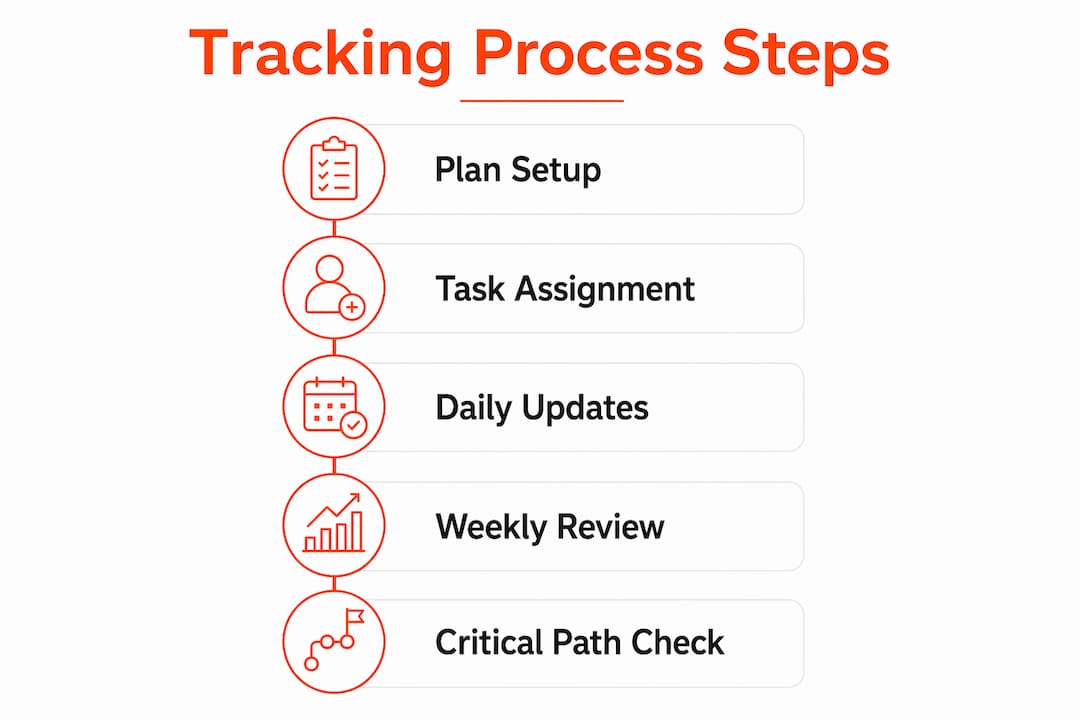
The most effective daily update process follows four steps:
- Record actual progress against each task at the end of the working day, not the following morning. Memory degrades overnight and site conditions change.
- Flag any blockers with a reason and an estimated resolution date. A blocked task without a resolution date is just a problem waiting to grow.
- Update the forecast completion date for any task that has moved, even by a single day. Accumulated small slips are how projects lose weeks.
- Escalate critical path impacts immediately to the project manager rather than waiting for the weekly review. A phase review held at the end of each phase is the formal checkpoint, but daily escalation handles the urgent cases.
Pro Tip: Run a five-minute end-of-day stand-up with trade leads rather than asking for written updates. Verbal updates are faster, and you can probe for blockers that people are reluctant to write down.
The difference between a project that finishes on time and one that does not often comes down to this discipline. Task tracking in construction is not a reporting exercise. It is a control mechanism, and it only works when updates are honest, timely, and acted upon.
How do weekly reporting loops improve schedule control?
Monthly reporting is structurally too slow for construction. A monthly review cycle means a problem identified on day two of a reporting period will not surface formally for another 28 days. By then, the delay has compounded and the options for recovery have narrowed.
Weekly updates allow project managers to see within minutes whether the critical path has shifted or whether delay is accumulating. That speed of insight is the practical difference between proactive and reactive management.
Combining field observations with schedule analytics gives you a complete picture. Without both data sources, a project can appear on track in the schedule while being weeks behind in reality. A subcontractor who reports 80% complete but has not yet ordered the materials for the remaining 20% is a classic example.
The key metrics to track in your weekly reporting loop are:
- Schedule variance (SV): planned progress minus actual progress, expressed in days
- Float consumption rate: how quickly tasks are burning through their buffer
- Blocked task count: the number of tasks currently unable to proceed
- Forecast completion date: updated weekly based on current trajectory, not original plan
Well-structured construction reporting tools can reveal the active state of a project in under five minutes. That speed depends on data quality. If field teams are not submitting accurate daily updates, the dashboard will show a false picture.
| Metric | What it tells you | Review frequency |
|---|---|---|
| Schedule variance | Days ahead or behind plan | Weekly |
| Float consumption | Risk of critical path impact | Weekly |
| Blocked task count | Active constraints on progress | Daily |
| Forecast completion | Revised end date based on current data | Weekly |
| Phase completion % | Progress within each work stage | Weekly |
Digital platforms consolidate this data without requiring manual calls to site. Real-time progress updates fed from site into a central dashboard give the project manager a live view rather than a historical snapshot.
What external constraints must your tracking template capture?
Standard scheduling templates often ignore the factors that actually stop work on site. Weather windows, permit approvals, subcontractor availability, and supplier lead times are external constraints that sit outside the schedule but directly affect it. Ignoring them creates a false sense of control and sets up cascading delays.
Each external constraint needs the same treatment as a task: an owner, a status, and a resolution date. A permit application without an owner is a risk. A permit application with a named owner, a submission date, and a chased response date is a managed item.
The most common external constraints on UK construction projects include:
- Weather dependency: groundworks, roofing, and external cladding all have weather windows. Track forecast conditions against planned activity dates.
- Permit and approval timelines: Building Control inspections, planning conditions, and utility connections each have lead times that must sit in the schedule, not in someone’s email inbox.
- Supplier delivery lead times: long-lead items such as structural steel, bespoke glazing, and specialist M&E equipment need procurement dates tracked separately from installation dates.
- Subcontractor availability: a subcontractor who is overcommitted on another site is a constraint. Track their confirmed mobilisation date, not their verbal commitment.
- Utility connections: network operators in the UK regularly cause delays. Track application dates, reference numbers, and estimated connection dates as formal schedule items.
Visible blockers with reasons and resolution timelines allow proactive mitigation before the schedule takes a hit. A blocker that is visible to the whole project team gets resolved faster than one sitting in a single person’s to-do list.
Key takeaways
Effective construction project tracking requires a weekly feedback loop, named task ownership, and active management of both critical path tasks and external constraints.
| Point | Details |
|---|---|
| Weekly loops beat monthly reviews | Weekly updates catch critical path shifts before they compound into unrecoverable delays. |
| Critical path tasks need priority attention | Tasks with zero float must be tracked daily; a single slip directly moves the project end date. |
| Every task needs one named owner | Generic team assignment causes slippage; individual accountability drives timely updates. |
| External constraints belong in the schedule | Weather, permits, and lead times must have owners and resolution dates, not just notes. |
| Monitoring without action is not control | Data collection only delivers value when it triggers escalation and corrective decisions. |
The gap between tracking and actually being in control
I have reviewed dozens of construction programmes over the years, and the pattern is consistent. Teams invest time in building a schedule at the start of a project and then treat it as a reference document rather than a live control tool. By week four, the schedule reflects the original plan. The site reflects something else entirely.
The uncomfortable truth is that most tracking failures are not technology failures. They are discipline failures. The weekly update does not happen because the project manager is firefighting. The daily blocker log does not get filled in because the site manager is too busy. The critical path slips by three days and nobody escalates because everyone assumes someone else is watching it.
What actually works is making the tracking process so simple that it happens by default. Short daily stand-ups. A single shared view of blocked tasks. A weekly review that takes 20 minutes, not two hours. The teams I have seen manage this well share one characteristic: they treat the schedule as a communication tool, not a reporting obligation.
The other issue I keep encountering is unreliable baseline schedules. You cannot track accurately against a programme that was built to win a tender rather than to reflect how the work will actually be sequenced. Fixing the baseline is not glamorous, but it is the foundation everything else depends on.
— James
How BRCKS supports project tracking on UK construction sites
Construction teams that track projects well share one habit: they capture information at the point it happens, not hours later at a desk.

BRCKS is built around that principle. It captures site updates, RFIs, and variation records in real time through WhatsApp, turning everyday messages into a structured project record without adding administrative work. Project managers get a live view of task status, blocked items, and site progress through a single dashboard. Clients get a dedicated portal with the information they need, without disrupting the site team. If you manage construction projects in the UK and want a construction management tool that works the way your team already communicates, BRCKS offers a 14-day free trial with no setup cost.
FAQ
What is project tracking in construction?
Project tracking in construction is the process of measuring actual progress against a planned schedule to identify delays and enable corrective action. The recognised industry term for this discipline is project controls.
What is the critical path and why does it matter for tracking?
The critical path is the sequence of tasks with zero float, meaning any slip directly moves the project end date. Tracking critical path tasks daily is the most direct way to protect project delivery dates.
How often should construction project updates be recorded?
Weekly schedule updates are the minimum effective frequency, with daily updates on blocked tasks and critical path items. Monthly reporting cycles are too slow to catch compounding delays before they become unrecoverable.
What are the most important construction performance metrics to track?
Schedule variance, float consumption rate, blocked task count, and forecast completion date are the four metrics that give the clearest picture of project health in a weekly reporting loop.
How does task ownership reduce construction delays?
Assigning every task to one named individual creates direct accountability for progress and updates. Generic team assignment is a leading cause of coordination failures, which drive the majority of construction delays.
Recommended
- Construction Task Tracking: A UK Project Manager’s Guide
- UK Construction Project Management Terminology Guide | BRCKS
- Decision Tracking for UK Residential Projects | BRCKS
- UK Construction Project Coordination Best Practices 2026 | BRCKS
How BRCKS Can Help
Effective project tracking is the backbone of any successful build, ensuring that UK teams stay on programme and within budget despite the industry’s inherent complexities. BRCKS simplifies this process by providing a centralised platform that streamlines site reporting and real-time data management, removing the guesswork from your daily operations. By integrating these digital tools into your workflow, you can move away from fragmented spreadsheets and focus on delivering high-quality results. We invite you to explore how BRCKS can transform your project oversight and help your team build with greater confidence. Learn more at BRCKS and explore our full feature set.